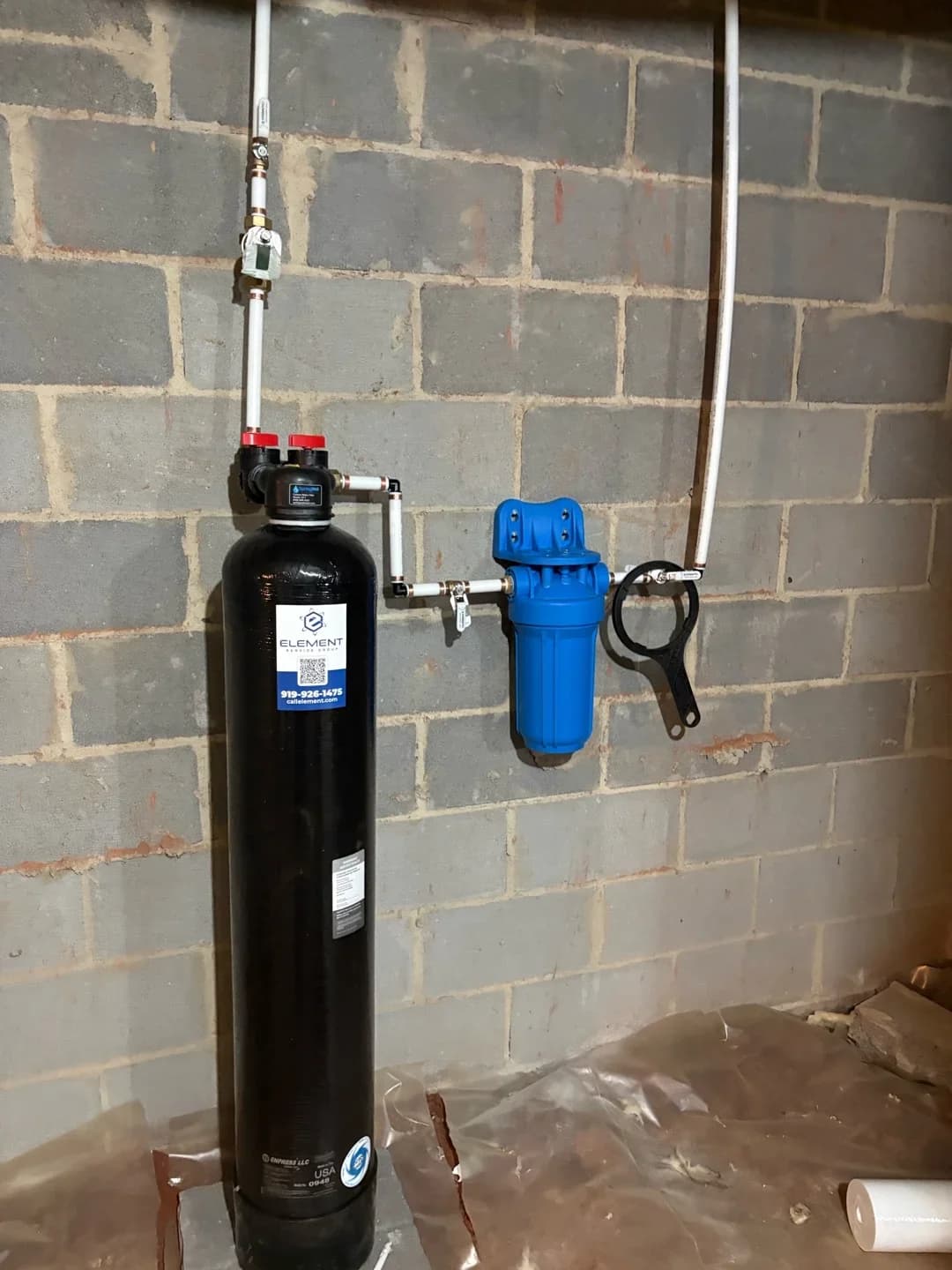
Your tap water is almost certainly safe to drink by EPA standards, and a water filtration system takes it a step further. But "meets minimum federal requirements" and "this is what I want my family drinking" are two different bars. Triangle city water passes EPA testing, but it still carries disinfectant (chlorine or chloramine, depending on the utility and time of year) and trace amounts of PFAS (per- and polyfluoroalkyl substances, the so-called "forever chemicals"). A filtration system doesn't fix unsafe water. It takes already-safe water and makes it genuinely clean.
What you notice day to day without filtration: water that smells or tastes like chlorine, dry skin and hair after showering, and a faint chemical taste that you've probably gotten used to but visitors notice immediately. A properly matched filtration system takes care of the taste and smell.
What's Actually in Triangle Water
Apex and Cary get their water from Jordan Lake, treated at the Cary/Apex plant. Raleigh draws mostly from Falls Lake. Utilities often use chloramine (a combination of chlorine and ammonia) as a long-lasting disinfectant. Chloramine is harder to remove than free chlorine. Standard carbon pitcher filters reduce it but don't eliminate it. You need catalytic carbon or a multi-stage system to truly remove chloramine.
PFAS compounds have been detected in municipal water supplies across North Carolina. These synthetic chemicals don't break down naturally and have been linked to health concerns at elevated exposure levels. The EPA has set drinking water limits for some PFAS, and local utilities publish their results in their annual water quality reports. Even when the numbers are below the limits, many homeowners would rather filter out what they can. Reverse osmosis and certain activated carbon systems are effective at PFAS reduction.
Most Triangle city water is on the soft side. Hardness is more often a well water problem, and well water hardness varies a lot from one home to the next. Filtration and softening address different problems. A carbon filter removes chemicals and improves taste. A softener handles mineral hardness. Some homes need both.
Well Water: A Different Set of Challenges
Homes on well water in western Wake County and outlying areas face issues that municipal water doesn't have. Well water bypasses all city treatment, so what's in the ground is what's in your glass.
Common well water problems in this area include iron (causes orange staining on fixtures, metallic taste), sulfur (rotten egg smell), low pH (acidic water that corrodes copper pipes), and bacterial contamination that requires UV treatment or chlorine injection. We test your water at your home with our own equipment, give you the results during the visit, and design a system around them, not a one-size-fits-all package.
Types of Filtration Systems
Under-sink reverse osmosis (RO). This is the most thorough option for drinking water at a single tap, usually the kitchen. An RO system forces water through a semi-permeable membrane that removes most dissolved contaminants, including PFAS, lead, fluoride, and dissolved minerals. Its carbon pre-filters handle chlorine and chloramine. Cost is typically $400-$800 installed, with filter replacements running $50-$100 annually. Downsides: it only treats one tap, it wastes some water during the filtration process, and it strips beneficial minerals (easily solved with a remineralization stage).
Whole-home carbon filtration. This system treats every tap, shower, and appliance in the house. A quality catalytic carbon system removes chloramine, chlorine, sediment, and many organic chemicals. The chlorine smell goes away at every tap and shower. Cost runs $1,200-$3,000 installed depending on system size and your home's plumbing configuration. Filters or media last 3-5 years before replacement.
Whole-home multi-stage systems. For homes with multiple water quality issues (hardness plus chemicals, or well water with iron plus low pH), we design systems that address each problem in sequence. The stages might include sediment pre-filtration, water softening, carbon filtration, and UV disinfection. These range from $2,500-$6,000+ depending on complexity.
How to Figure Out What You Need
Start with a water test. Element Service Group offers a free water quality consultation where our tech tests your water at your home with professional-grade equipment, gives you the results during the visit, and reviews your utility's latest water quality report if you're on city water. Based on the results, we recommend a system matched to your actual water chemistry, not the most expensive option on the shelf.
Ask yourself what you're trying to solve. If it's just drinking water taste and you want to remove PFAS, an under-sink RO system handles that affordably. If you're tired of chlorine smell and taste throughout the house, or you're on well water with scale and staining, you need a whole-home solution. If you have well water with multiple issues, you need a multi-stage approach.
Installation and Maintenance
We install every system ourselves, no subcontractors. Whole-home systems get plumbed into your main water line with a bypass valve so you can isolate the system for maintenance. Under-sink systems get connected with a dedicated filtered water faucet at your kitchen sink.
Every system needs periodic maintenance. We set you up on a schedule and can handle filter changes and system checks as part of ongoing service. A neglected filtration system can actually make water quality worse by harboring bacteria in old filters, so maintenance matters.
Element Service Group is veteran-owned with over 900 five-star reviews across the Triangle. We don't sell one brand or push oversized systems. We test your water, match a solution to the results, and install it right.